
Every kilogram launched from Earth’s surface has to fight its way up a gravity well eleven kilometers per second deep. That single fact shapes the entire economics of spaceflight: propellant, water, structural metal, and radiation shielding are cheap materials made ruinously expensive by the ride. Meanwhile, more than 41,000 near-Earth asteroids have been catalogued — a number that has quadrupled since 2016 and grows by thousands every year as survey telescopes improve. A meaningful fraction of those bodies sit in orbits so favorable that a round trip requires less total velocity change than landing on and returning from the Moon. They are, in effect, warehouses that drifted into the neighborhood.
The question asteroid mining actually answers is not “how do we bring platinum home?” It is “how do we stop launching things we could pick up along the way?” Space Dust Industries approaches that question the way we approach everything: as an autonomy problem first. The physics of extraction is well understood. What does not yet exist is the machine intelligence that can prospect, decide, extract, and process millions of kilometers from the nearest human. That is the layer we are building.
Reading the Rock: What Asteroids Are Made Of
Asteroids are not interchangeable gravel. Spectral taxonomy sorts them into families, and each family is a different kind of ore body.
C-type (carbonaceous) asteroids are the most common, dark as charcoal, and the most immediately valuable — not for metals, but for volatiles. Their clays and hydrated minerals can hold water at several percent to roughly ten percent by mass, alongside carbon compounds, nitrogen, and sulfur. Water is life support, radiation shielding, and — split into hydrogen and oxygen — the highest-performing chemical propellant we know.
S-type (silicaceous) asteroids are stony bodies rich in silicates with embedded nickel-iron metal grains, the parent material of the most common meteorites that reach the ground.
M-type (metallic) asteroids appear to be dominated by nickel-iron alloy — in some cases possibly the shattered cores of early planetesimals — laced with cobalt and platinum-group metals at concentrations that would count as high-grade ore on Earth.
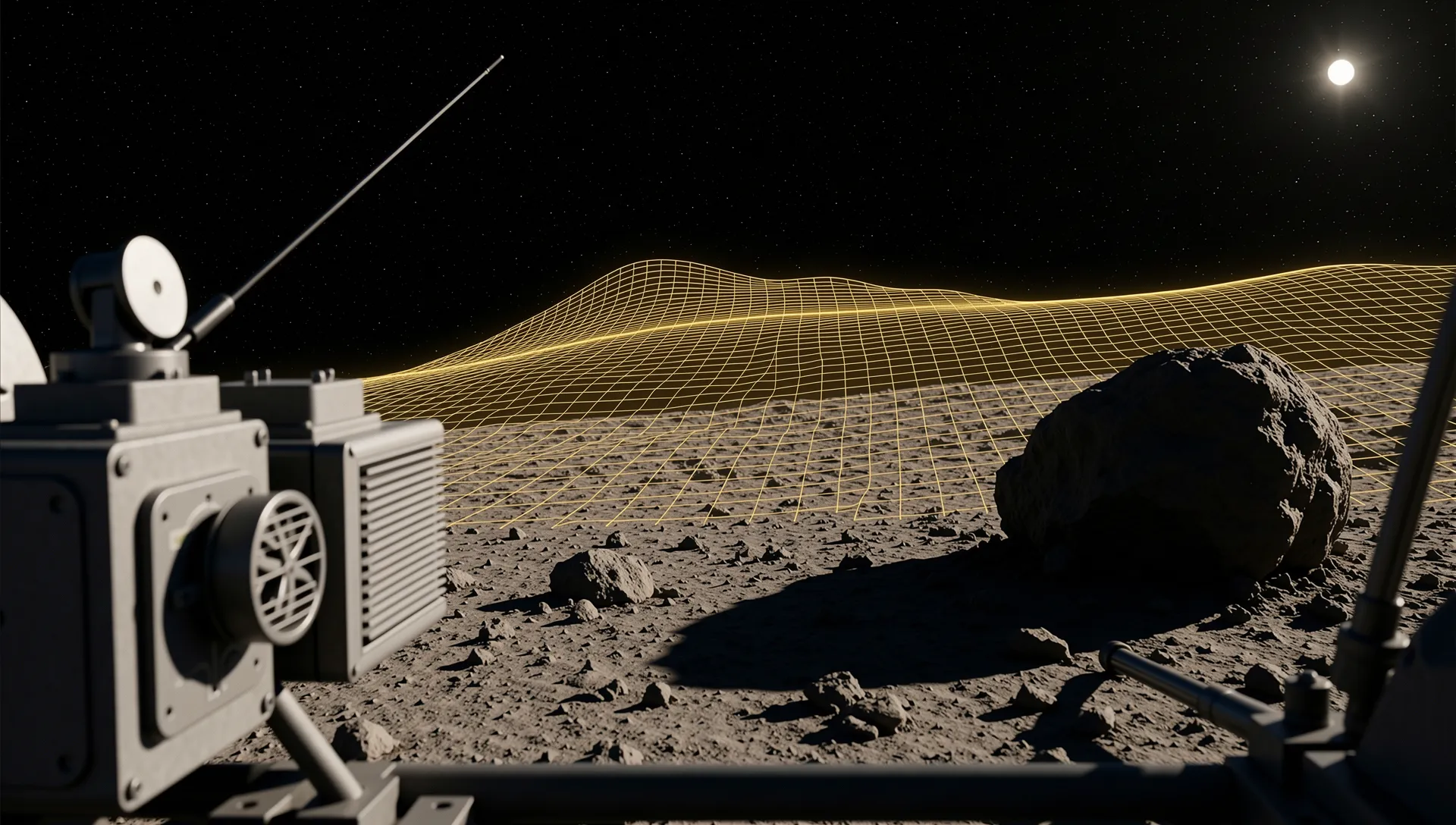 Prospecting is the phase where missions are won or lost: composition must be confirmed before extraction hardware ever commits.
The catch is that a telescope classification is a hypothesis, not an assay. Ground-based spectra sample only the sunlit surface, and space weathering can mask what lies centimeters below. Real prospecting means going there — which is why the sample-return missions of the past decade matter so much.
What the Pathfinder Missions Proved
The field stopped being theoretical in the 2020s. Japan’s Hayabusa2 returned samples of the C-type asteroid Ryugu in 2020 and found more than twenty amino acids and mineral evidence of liquid water on its parent body; the spacecraft is still flying an extended mission toward a rendezvous with a tiny fast-rotating asteroid in the early 2030s. NASA’s OSIRIS-REx brought back 121 grams of Bennu in 2023, and the analyses published since have been remarkable: water-formed clays and carbonates, evaporite salts left behind by ancient brines, fourteen of the twenty amino acids used by life on Earth, and all five nucleobases of DNA and RNA. Bennu is, chemically, exactly the kind of volatile-rich feedstock a space economy needs.
The metallic end of the spectrum is next. NASA’s Psyche spacecraft, launched in 2023, completed a Mars gravity assist in mid-2026 and remains on course to orbit the metal-rich asteroid Psyche in 2029 — humanity’s first close look at what may be exposed planetesimal core material. And the private sector has entered the arena: AstroForge launched its Odin spacecraft toward a suspected metallic asteroid in early 2025. Odin was lost to communications failures, but the company has been open about the lessons learned and is preparing a larger, more capable successor, Vestri, intended to touch down on a metallic asteroid and measure its platinum-group metal content directly. Ambitions are outrunning results — which is precisely what the early days of a new industry look like.
Water Is the First Ore
The popular image of asteroid mining is platinum ingots raining down on commodity markets. The engineering and economic reality is humbler and far more compelling: the first profitable asteroid product will almost certainly be water, sold in space, to customers already in space.
The arithmetic is simple. Delivering a kilogram of anything to high Earth orbit or beyond still costs thousands of dollars, and most of what missions carry is propellant. A kilogram of water extracted from an asteroid already outside the gravity well skips that entire cost stack. Electrolyze it with solar power and you have hydrogen and oxygen — cryogenic bipropellant generated on site. A depot of asteroid-derived propellant in cislunar space would change mission design for everyone: satellites refueled instead of retired, deep-space missions staged rather than launched whole.
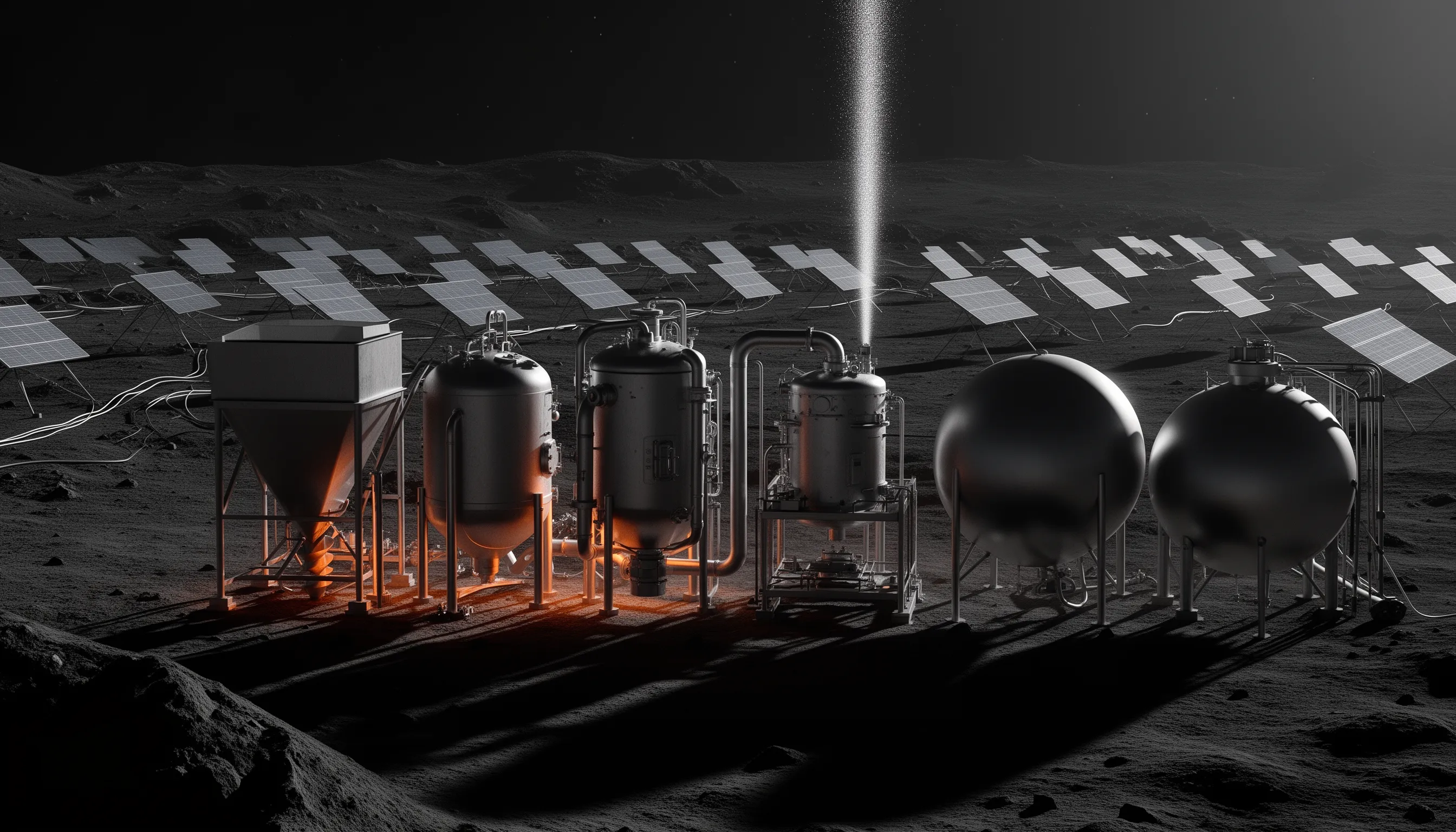 Our closed-loop propellant concept: harvested water, solar electrolysis, cryogenic storage — no supply line to Earth.
Extraction itself can be elegantly simple. Because asteroid water is bound in hydrated minerals, concepts like optical mining — studied under NASA’s advanced-concepts program — use concentrated sunlight to spall and bake regolith inside an enclosure, driving off volatiles for cold-trap capture, with few or no moving parts touching the rock. SDI’s research portfolio embraces the same design philosophy of using sunlight as the primary process energy. Our solar-thermal processing concept extends it to metals: concentrated solar furnaces reaching the temperatures needed to sinter and forge asteroid-derived alloys into structural stock, with no combustion and no consumables. We are honest about where this stands — these are concepts under development, validated in simulation and ground research, not flight hardware.
Moving Mass Without Burning It
A mine is only as good as its haul road. In space, the cruel irony is that moving material with rockets consumes the very propellant you came to make. The classical answer dates to Gerard O’Neill’s space-settlement work of the 1970s: the mass driver, an electromagnetic accelerator that flings payloads along a precisely aimed trajectory using electricity instead of propellant. On a body with escape velocity measured in centimeters per second, even a modest accelerator can put material on a transfer trajectory to an orbital processing station.
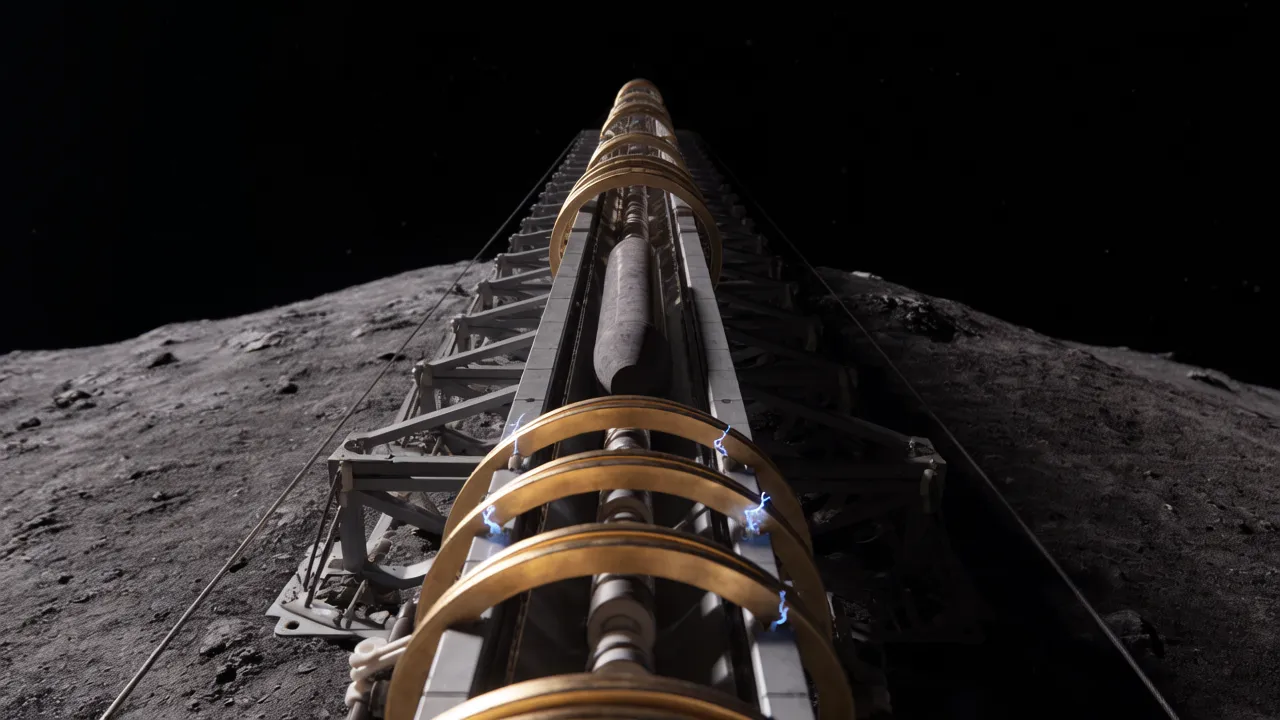 The Large Aggregate Cannon: SDI’s mass-driver concept study for propellant-free bulk transport from an asteroid’s surface.
Our Large Aggregate Cannon (LAC) concept is SDI’s contribution to that lineage: a compact, solar-powered electromagnetic launcher designed to accelerate packaged aggregate to gentle interception velocities, paired with a catcher craft at the receiving end. The unsolved problems are not electromagnetic — they are guidance, timing, and coordination, because a mass driver on a rotating, irregular body is useless without centimeter-class knowledge of its own state and its target’s. That is a navigation and control problem, and it is squarely in our lane. The same reasoning applies to the repair problem: any long-duration mining platform must fix itself, which is why our work on 3D scan-to-print pipelines and additive repair — building a part from a scan of the broken one — is foundational to the architecture rather than an accessory.
The Rules Already Exist
Asteroid mining is sometimes portrayed as a legal vacuum. It is not. The 1967 Outer Space Treaty bars national appropriation of celestial bodies but is broadly read to permit the use of resources extracted from them. The United States made that reading explicit in the Commercial Space Launch Competitiveness Act of 2015, which grants U.S. companies rights to resources they obtain in space. Luxembourg followed with its own framework in 2017, and the Artemis Accords — now signed by more than fifty nations — affirm that space resource extraction can be conducted consistently with the Outer Space Treaty and encourage transparent, deconflicted operations. For a U.S. company, the legal foundation for extracting and owning asteroid resources is settled enough to build on. The open questions are practical: coordination, safety zones, and norms that will be shaped by whoever operates first and operates well.
Why AI Is the Deciding Technology
Here is the constraint that dominates everything: light lag. A near-Earth asteroid at a typical operational distance is minutes to tens of minutes away by radio, round trip. No one will joystick a mining robot across that gap. Every consequential decision — where to anchor, where to drill, when a vibration signature means a failing bearing, whether a spectral reading justifies moving the whole operation fifty meters — must be made on site, by software.
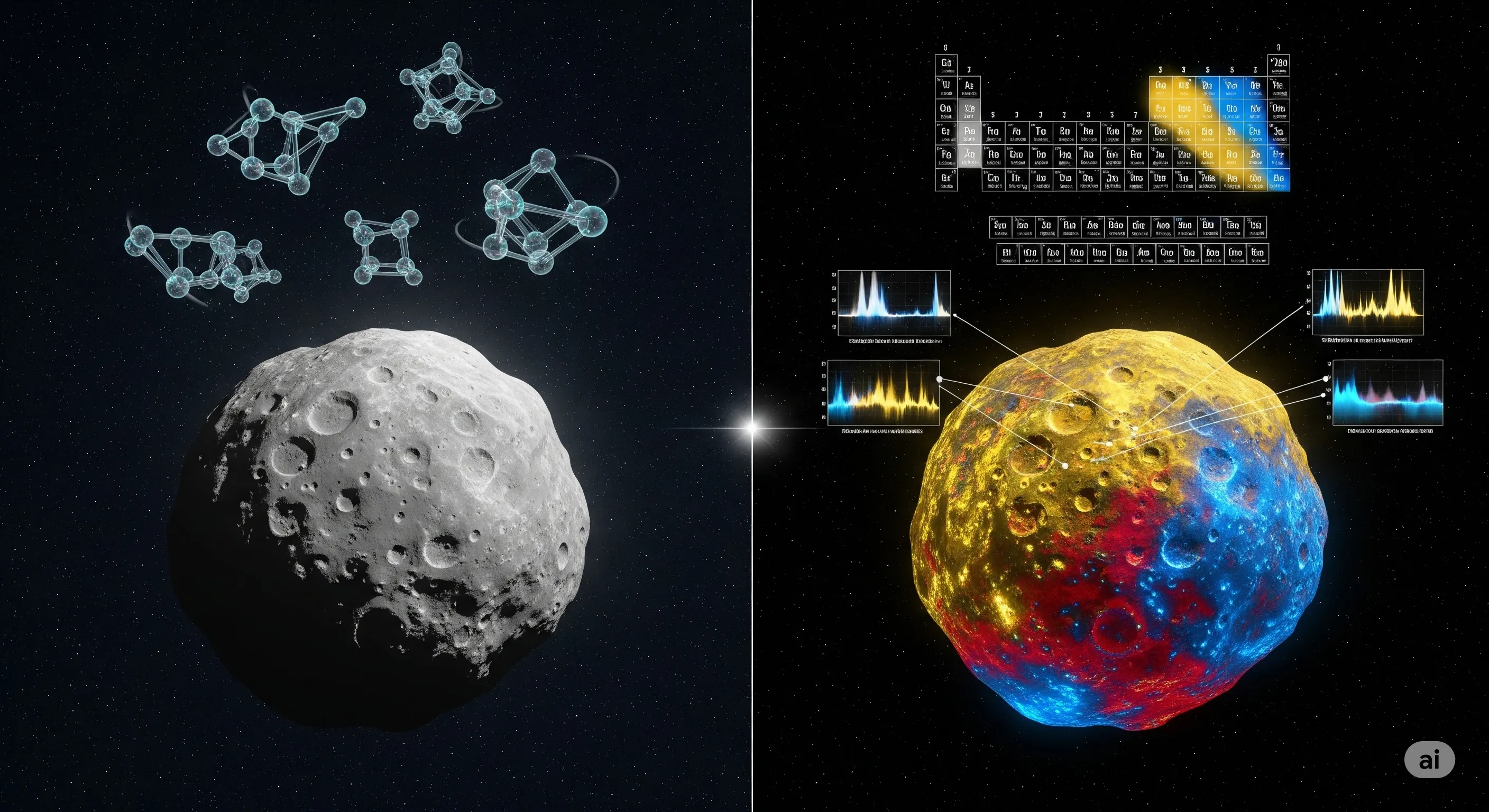 Machine learning applied to hyperspectral data: turning raw reflectance curves into mineral maps and extraction decisions.
This is where SDI’s actual, current work connects to the vision. On our on-premise multi-GPU research cluster, we train and evaluate exactly the model classes this future requires: perception networks that interpret spectral and geometric sensor data, reinforcement-learning agents that plan manipulation and excavation tasks in simulated microgravity environments, and resource-optimization models that allocate energy and machine time across competing objectives. Critically, we specialize in edge AI that runs entirely offline — no cloud, no connectivity assumptions — because a spacecraft at an asteroid is the ultimate disconnected edge device. An autonomy stack that cannot run within the power, compute, and isolation budget of deep space is a demo, not a product.
The Road Ahead
Space Dust Industries has not flown a mining mission, and we will not pretend otherwise. What we are doing is deliberately sequenced: building AI capability on the ground today — offline edge inference, robotic learning, scan-to-print manufacturing, spectral analysis research — that is valuable in terrestrial and government applications now and maps directly onto the autonomy layer asteroid mining will demand. The sample missions have proven the resources are there. The legal framework is in place. Launch costs are falling, and the first commercial prospectors are already flying and failing and flying again. The bottleneck that remains is trustworthy machine autonomy, and that is the problem we have chosen to spend this decade solving.